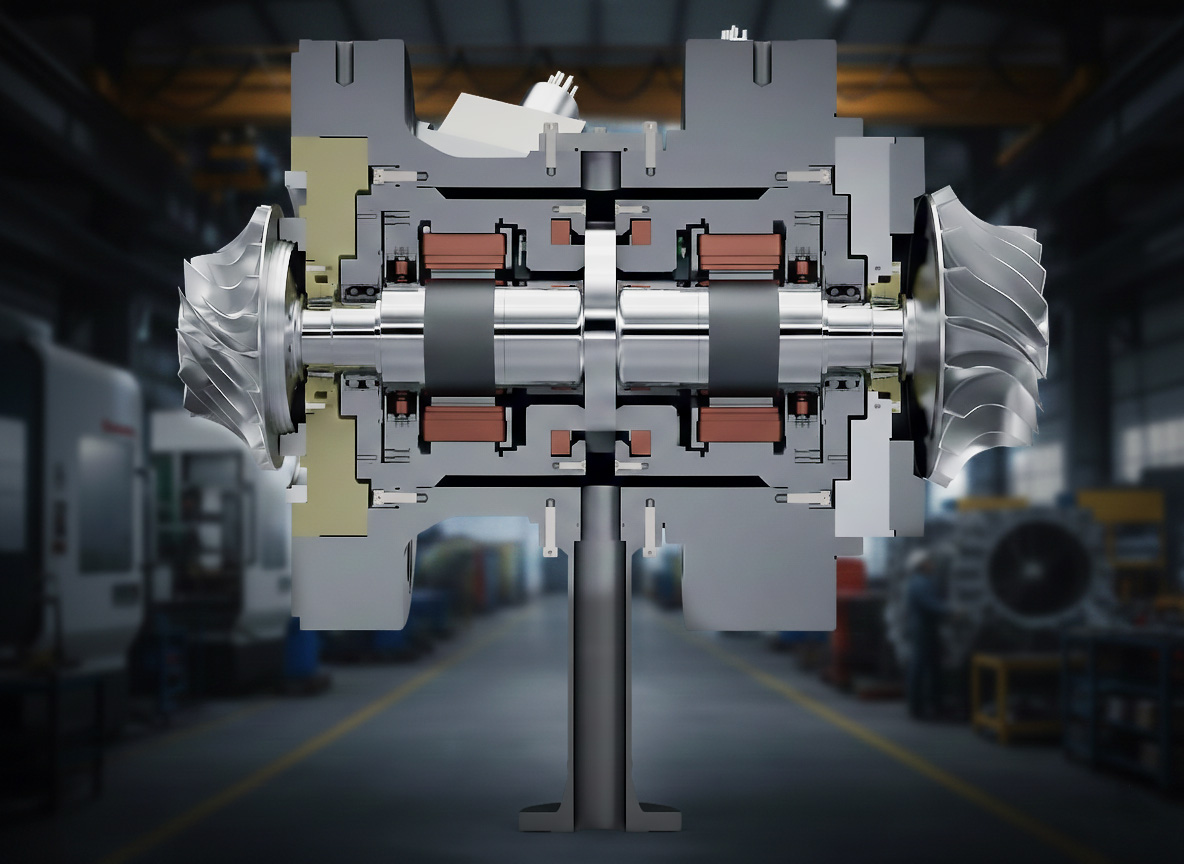
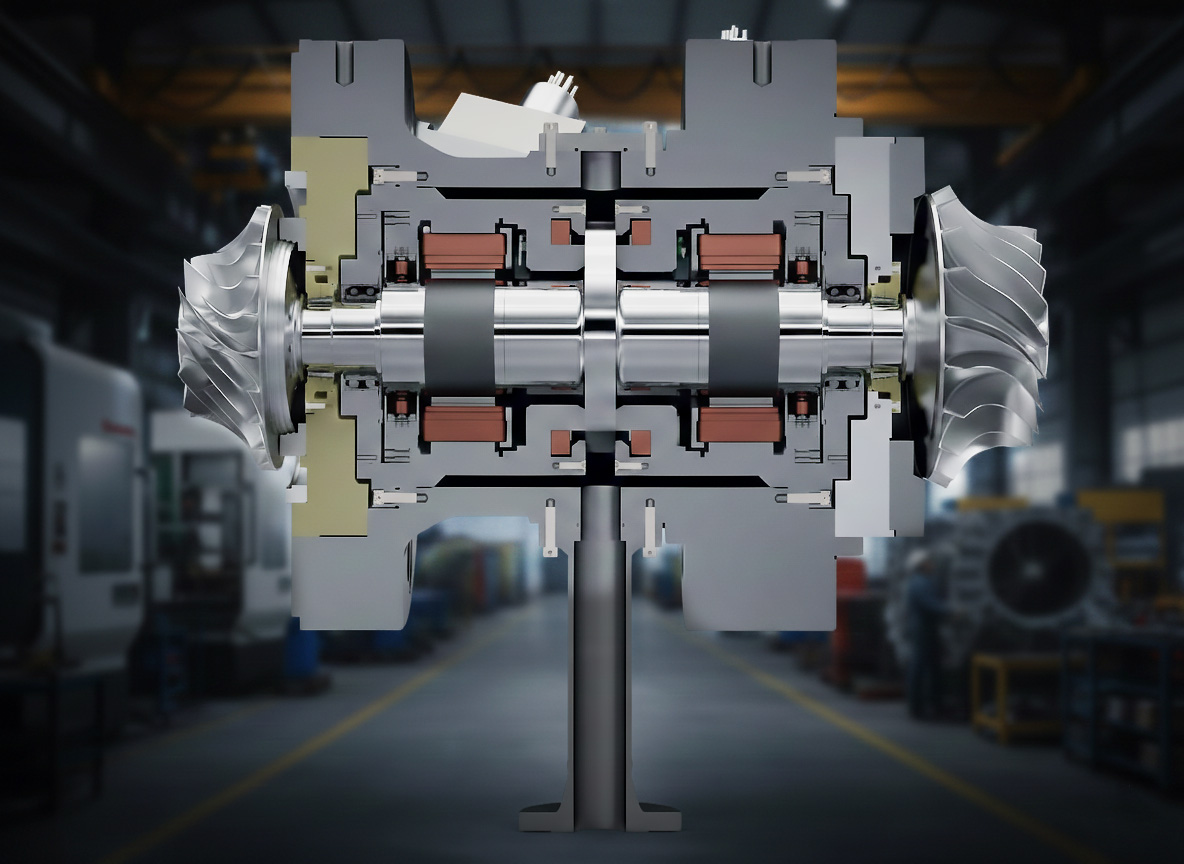
A single-shaft centrifugal compressor is a type of dynamic compressor in which all impellers are mounted on a common shaft and are rotated by a single driver (electric motor, steam turbine, or gas turbine).

Single-shaft centrifugal compressors are widely used in large-scale industrial applications such as gas transmission pipelines, refinery hydrocrackers, and petrochemical plants. Because all impellers are mounted on a single shaft and rotate at the same speed, these compressors offer excellent mechanical reliability and simplicity compared to multi-shaft integrally geared designs. They are particularly well-suited for high-flow, high-pressure-ratio services where steady-state operation is required for extended periods. The straightforward design also simplifies alignment, balancing, and maintenance procedures. Furthermore, single-shaft compressors can be directly driven by gas turbines or large electric motors without the need for complex gearboxes, reducing potential failure points and improving overall efficiency.
Despite their robustness and simplicity, single-shaft centrifugal compressors have notable limitations. Because all impellers must rotate at the same speed, the compressor cannot independently optimize the rotational speed for each impeller stage. This leads to reduced aerodynamic efficiency at off-design operating conditions compared to integrally geared compressors, where each pinion can run at its own optimal speed. Additionally, single-shaft designs typically require a larger physical footprint and higher initial capital investment due to the need for a heavier casing and larger bearings to support the combined rotor mass. They are also less flexible in handling widely varying flow requirements without the assistance of variable inlet guide vanes or recycle systems. Consequently, for applications requiring high efficiency across a broad operating range or multiple pressure levels, integrally geared compressors may be a more suitable choice.